
The Reserve Bank of India (RBI) maintained its key policy rates for the fourth consecutive time, keeping the repo rate at 5.25 per cent, while the benchmark BSE Sensex closed 152 points higher in a volatile session, recovering from an intraday dip.

Indian benchmark indices Sensex and Nifty extended their winning streak to a fourth consecutive day, driven by strong buying in blue-chip bank stocks and a decline in global crude oil prices. Fresh foreign fund inflows also contributed to the optimistic sentiment in the domestic equity market.

'Hiring within IT services firms is going to be very specialised.'

Indian IT service providers face heightened competition from AI-native firms in the next three years, potentially eroding their revenue base unless they remain competitive and protect recurring businesses, according to a report by S&P Global Ratings.

Indian stock market indices closed on a mixed note, with the Sensex gaining 374 points driven by buying in Reliance Industries and ICICI Bank, while the Nifty remained flat. This divergence is attributed to a new Closing Auction Session (CAS) mechanism introduced by stock exchanges, impacting market liquidity and price discovery.

In the next 36 months nearly 25 to 40 per cent of jobs will be under threat from AI and job losses are inevitable.
Indian equity benchmark indices Sensex and Nifty surged significantly in early trade, mirroring a global market rally and a drop in crude oil prices below USD 100 per barrel, driven by renewed hopes of diplomatic engagement between the US and Iran.

'Across the entire value chain, we will be able to industrialise AI adoption, and that is the main purpose of the deal.'

Indian equities on Dalal Street saw volatility. Track Sensex, Nifty50 movement and key market drivers for Feb 25, 2026.

Indian IT stocks experienced a significant downturn following OpenAI's acquisition of consulting firm Tomoro, intensifying fears that global AI companies are encroaching on traditional IT service models through end-to-end consulting and implementation services.

Indian benchmark equity indices, Sensex and Nifty, extended their rally for a fifth consecutive session, driven by optimism surrounding a potential US-Iran peace deal and a significant drop in crude oil prices. Despite hawkish remarks from the US Fed, investors remain hopeful that easing energy prices could temper inflationary pressures.
Indian benchmark stock indices, Sensex and Nifty, surged over 1 per cent, driven by optimism surrounding potential US-Iran peace talks and a significant drop in crude oil prices below the USD 100 per barrel mark. This de-escalation in geopolitical concerns and easing inflation pressures provided a substantial boost to investor sentiment.
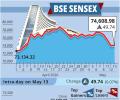
Indian benchmark equity indices, Sensex and Nifty, closed marginally higher, breaking a four-day losing streak, despite elevated crude oil prices and ongoing geopolitical uncertainties. The market saw a temporary pause in panic selling, though cautious sentiment persists.
Tata Consultancy Services' (TCS) annual dividend payout declined to a four-year low of approximately 39,820 crore in FY26, marking its steepest decline in a decade and potentially adversely affecting Tata Sons' finances, which heavily rely on TCS's dividend income.

Global semiconductor giant AMD projects the overall market for compute infrastructure, driven by artificial intelligence, to reach USD 2 trillion by 2030 from USD 365 billion in 2025. The company unveiled new products and its Helios AI infrastructure, emphasising an open ecosystem and significant performance gains over competitors, with India playing a key role in its global rollout.
Global semiconductor giant AMD projects the overall market for compute infrastructure, driven by artificial intelligence, to reach USD 2 trillion by 2030 from USD 365 billion in 2025. The company unveiled new products and its Helios AI infrastructure, emphasising an open ecosystem and significant performance gains over competitors, with India playing a key role in its global rollout.

Indian stock market benchmark indices, Sensex and Nifty, experienced declines in early trade due to escalating tensions between the US and Iran, which led to a surge in crude oil prices and weak global equity trends.

Tata Consultancy Services (TCS) has extended 25,000 offers to freshers for the current fiscal year (FY27), with future hiring decisions contingent on the demand scenario, according to CEO K Krithivasan.
Tata Sons' unlisted ventures, including Air India, Tata Digital, and Tata Electronics, reported combined net losses of approximately 25,568.8 crore in FY25, a 58.3 per cent increase from the previous year, despite Tata Sons itself remaining profitable for over a decade.

Indian equity benchmark indices Sensex and Nifty declined in early trade, driven by persistent concerns over the unresolved US-Iran situation and continued outflows from foreign institutional investors.

Indian benchmark indices Sensex and Nifty closed lower, snapping a two-day rally, as a spike in crude oil prices, triggered by reports of fresh US military operations in southern Iran, dampened investor sentiment and reignited fears of renewed energy supply disruptions.
Indian benchmark equity indices Sensex and Nifty surged in early trade, driven by a sharp correction in crude oil prices below USD 100 per barrel and a rally in global markets, fuelled by improving sentiment surrounding US-Iran negotiations.

Union Agriculture Minister Shivraj Singh Chouhan announced plans to establish a unit of the Tata Memorial Hospital in Vidisha, Madhya Pradesh, to provide advanced cancer treatment locally. He also inaugurated a free cancer screening camp and urged public awareness about early detection and prevention, including a social movement against substance abuse.

OpenAI and Anthropic are not simply enabling new software capabilities, they are moving directly into enterprise execution, workflow ownership, and decision orchestration.

The India-US trade deal has offered a much-needed breather for the Indian information technology (IT) industry, which has been grappling with global macroeconomic uncertainty and subdued client spending over the past few years.

Companies listed on the National Stock Exchange (NSE) main board increased their Corporate Social Responsibility (CSR) expenditure by 23 per cent year-on-year to Rs 22,212 crore in 2024-25 (FY25), driven by a significant jump in average net profits, according to a PRIME Database Group report.

Indian benchmark equity indices, Sensex and Nifty, ended lower after a five-day rally, with the Sensex dropping 607 points and the Nifty falling to 24,013.10. The decline was primarily driven by heavy selling in IT firms following Accenture's trimmed revenue guidance and renewed geopolitical uncertainty, specifically the postponement of US-Iran negotiations.
Indian benchmark indices, Sensex and Nifty, closed marginally higher after a volatile trading session, driven by value buying in IT and select blue-chip counters, despite global crude price hikes and a weak rupee.

Sensex gains over 400 points while Nifty trades above 23,800 amid strong IT sector buying.

Indian benchmark indices Sensex and Nifty experienced a significant slump in early trade, mirroring a sharp decline in global equities and a fresh spike in crude oil prices, exacerbated by simmering tensions in West Asia and a global unwinding of the AI-led rally. Track how sensex, Nifty fared on June 8.

"There is a sharp jump that we have seen in bookings of EVs... The jump, at least in our case, in just two months, it is about 2 to 2.5 times of what it used to be"

India's first trillion-dollar company will be built on technology it owns, not just operates, predicts Ajay Kumar.

Market sentiment is likely to remain cautious as investors position themselves for the upcoming Union Budget and the US Fed's interest rate decision, where expectations are muted.
Indian benchmark indices Sensex and Nifty experienced a significant tumble in early trade, driven by surging global oil prices, continuous outflows by Foreign Institutional Investors (FIIs), and persistent geopolitical uncertainties, particularly in West Asia.
Indian markets on Dalal Street rallied sharply as easing tensions in the US-Iran conflict and stable oil prices boosted sentiment. Track Nifty 50 and BSE Sensex performance and key global triggers.
Indian stock market indices Sensex and Nifty experienced a decline in early trade due to surging crude oil prices and ongoing geopolitical uncertainty in West Asia. Foreign fund outflows further contributed to the negative sentiment.
Indian investors have seen their wealth erode by a staggering Rs 16.77 lakh crore over four trading sessions, as the markets faced deep losses driven by elevated crude oil prices, geopolitical tensions, persistent foreign fund outflows, and a record-low rupee.

These offers provide some relief to engineering students impacted by the uptake in artificial intelligence (AI) tools.

Recent controversies at major IT firms like TCS and Infosys have highlighted a persistent gap between workplace conduct policies and their implementation in corporate India. While companies assert zero tolerance for harassment and discrimination, employees and experts point to uneven enforcement and the need to embed ethical behaviour into organisational culture.

Indian stock markets saw a significant rebound, with the Sensex jumping nearly 790 points, primarily fuelled by strong buying interest in telecom, pharma, and private banking shares, despite a volatile trading session and a weakening rupee.
